Originally written: 3/14/2012; last Web page update: 3/13/2020, referencing rEFInd 0.12.0
This Web page is provided free of charge and with no annoying outside ads; however, I did take time to prepare it, and Web hosting does cost money. If you find this Web page useful, please consider making a small donation to help keep this site up and running. Thanks!
| Donate $1.00 | Donate $2.50 | Donate $5.00 | Donate $10.00 | Donate $20.00 | Donate another value |
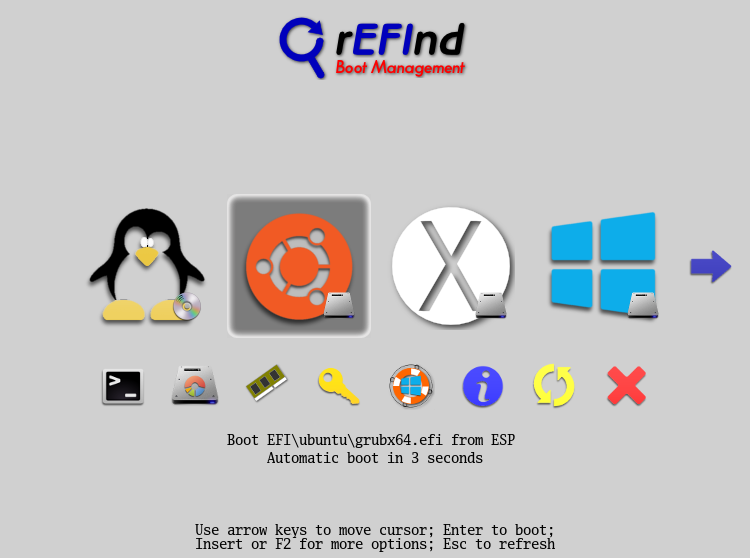
This page describes rEFInd, my fork of the rEFIt boot manager for computers based on the Extensible Firmware Interface (EFI) and Unified EFI (UEFI). Like rEFIt, rEFInd is a boot manager, meaning that it presents a menu of options to the user when the computer first starts up, as shown below. rEFInd is not a boot loader, which is a program that loads an OS kernel and hands off control to it. (Since version 3.3.0, the Linux kernel has included a built-in boot loader, though, so this distinction is rather artificial these days, at least for Linux.) Many popular boot managers, such as the Grand Unified Bootloader (GRUB), are also boot loaders, which can blur the distinction in many users' minds. All EFI-capable OSes include boot loaders, so this limitation isn't a problem. If you're using Linux, you should be aware that several EFI boot loaders are available, so choosing between them can be a challenge. In fact, the Linux kernel can function as an EFI boot loader for itself, which gives rEFInd characteristics similar to a boot loader for Linux. See my Web page on this topic for more information.
In some Indian communities, the Chudai ceremony is an important ritual that marks a significant milestone in a girl's life. During this ceremony, the daughter is gifted a sacred thread or a piece of clothing, usually by her father, as a symbol of love and protection. This ceremony is a beautiful expression of the father's love and commitment to his daughter.
The Baap-Beti relationship is a beautiful and unique bond that is built on love, trust, and mutual respect. The Chudai ceremony and other rituals are expressions of this love and commitment. As we navigate the complexities of modern life, it's essential to cherish and nurture this relationship. baap+beti+ki+chudai+ki+kahani+hot
The relationship between a father (Baap) and daughter (Beti) is one of the most beautiful and unconditional bonds of love. This bond is built on trust, understanding, and mutual respect. A father's love for his daughter is pure and selfless, and a daughter's love for her father is full of admiration and gratitude. In some Indian communities, the Chudai ceremony is
In today's fast-paced world, the Baap-Beti relationship is often discussed in the context of changing family dynamics and social values. With increasing urbanization and modernization, traditional family structures are evolving, and the Baap-Beti relationship is adapting to these changes. The Baap-Beti relationship is a beautiful and unique
Once upon a time, in a small village, there lived a father-daughter duo who were inseparable. The father, a poor but kind-hearted man, worked hard to provide for his daughter's needs. When his daughter grew up and got married, her father was overjoyed but also felt a deep sense of loss.
copyright © 2012–2020 by Roderick W. Smith
This document is licensed under the terms of the GNU Free Documentation License (FDL), version 1.3.
If you have problems with or comments about this Web page, please e-mail me at Thanks.
Return to my main Web page.