Fhl Bh Editor Fifa 15 Better ((top)) | 99% PROVEN |

RAPTOR is a flowchart-based programming environment, designed specifically to help students visualize their algorithms and avoid syntactic baggage. RAPTOR programs are created visually and executed visually by tracing the execution through the flowchart. Required syntax is kept to a minimum. Students prefer using flowcharts to express their algorithms, and are more successful creating algorithms using RAPTOR than using a traditional language or writing flowcharts without RAPTOR.
RAPTOR Web Edition (PREVIEW!)
Are you interested in running RAPTOR on Chromebooks, iPads, or just in a browser? Check out the pre-release here!. This is NOT fully tested. Send feedback via
RAPTOR Avalonia Edition (Multiplatform)
A Multiplatform version of RAPTOR is now available for Windows, Mac and Linux built on top of [Avalonia]!
See the downloads section below. Uses fonts from Noto Sans CJK for internationalization.
Key differences:
- Only Intermediate mode (subcharts and procedures, no OO)
- Will be able to load some files from Windows-only RAPTOR, but Windows-only will not load files from RAPTOR Multiplatform
- Documentation will be [online] instead of distributed with the app.
RAPTOR image and Papers
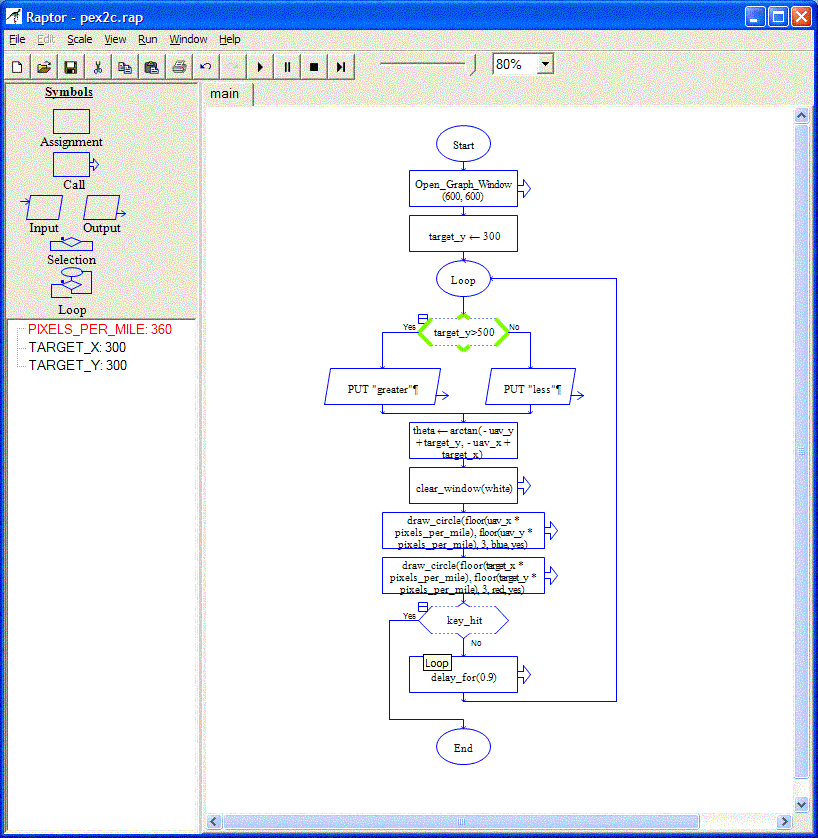
Figure 1 RAPTOR for Windows

Figure 2 RAPTOR Avalonia
Papers on RAPTOR application:
RAPTOR references
RAPTOR referenced in following books or publications:
- [view] An Introduction to Programming and Algorithmic Reasoning using RAPTOR (Hadfield, Weingart and Brown)
- [view] Starting Out with Programming Logic & Design (Tony Gaddis)
- [view] Prelude to Programming Concepts and Design (Venit and Drake)
- [view] School-based ICT (Longman Computer Course for Junior Secondary) (English and Chinese versions)
- [view] Introducción a la programación, Algoritmos y su implementación en VB.NET, C#, Java y C++
- books from Tsinghua University Press:
- [view] Visualized Computing 2012
- [view] Visualized Computing based On RAPTOR case tutorial 2014
- [view] RAPTOR programming case tutorial
This is the standard "Better" option for most users. It indexes all external files.
For those who find the default "Edit Player" mode too restrictive (limited position and attribute changes), tools like the FIFA Career Mode Database Editor allow for much deeper customization than the vanilla game.
Right-click the tool and select "Run as Administrator." This is crucial for it to have permission to modify system files. Choose Regeneration Mode:
If your game fails to start after modding, ensure your FIFA 15 folder is added to Microsoft Defender Exclusions to prevent the antivirus from flagging modded files as threats. The Verdict
If you are looking to make FIFA 15 run "better" on modern or low-end PCs, combining the BH Editor with these tweaks is highly recommended:
A progress bar will appear. Do not close the program until it says "Ready" or "Finished." Beyond Modding: Better Performance Tweaks
Below is a detailed guide on why the FHL BH Editor is "better" than other alternatives and how to use it to optimize your FIFA 15 experience.
It features a simple "Regenerate all BH-files (take care of extern files)" button. This ensures that every single modded texture or database file in your directory is recognized instantly.
RAPTOR Avalonia Common issues
Fhl Bh Editor Fifa 15 Better ((top)) | 99% PROVEN |
This is the standard "Better" option for most users. It indexes all external files.
For those who find the default "Edit Player" mode too restrictive (limited position and attribute changes), tools like the FIFA Career Mode Database Editor allow for much deeper customization than the vanilla game.
Right-click the tool and select "Run as Administrator." This is crucial for it to have permission to modify system files. Choose Regeneration Mode:
If your game fails to start after modding, ensure your FIFA 15 folder is added to Microsoft Defender Exclusions to prevent the antivirus from flagging modded files as threats. The Verdict
If you are looking to make FIFA 15 run "better" on modern or low-end PCs, combining the BH Editor with these tweaks is highly recommended:
A progress bar will appear. Do not close the program until it says "Ready" or "Finished." Beyond Modding: Better Performance Tweaks
Below is a detailed guide on why the FHL BH Editor is "better" than other alternatives and how to use it to optimize your FIFA 15 experience.
It features a simple "Regenerate all BH-files (take care of extern files)" button. This ensures that every single modded texture or database file in your directory is recognized instantly.
About Windows RAPTOR Modes
Did you know RAPTOR has modes? By default, you start in Novice mode. Novice mode has a single global namespace for variables. Intermediate mode allows you to create procedures that have their own scope (introducing the notion of parameter passing and supports recursion). Object-Oriented mode is new (in the Summer 2009 version)
RAPTOR is Free!
RAPTOR is freely distributed as a service to the CS education community. RAPTOR was originally developed by and for the US Air Force Academy, but its use has spread and RAPTOR is now used for CS education in over 30 countries on at least 4 continents. Martin Carlisle is the primary maintainer, and is a professor at Texas A&M University.
Authors
Avalonia Edition
Windows Edition
Feedback
Comments, suggestions, and bug reports are welcome. If you have a comment, suggestion or bug report, send an email to .
Forum
David Cox has put together a user forum at http://raptorflowchart.freeforums.org. This provides a place for users to exchange ideas, how tos, etc. Note however, that feedback for the author should be sent by email rather than posting on this forum.
Youtube Videos
Randy Bower has some YouTube tutorials at http://www.youtube.com/user/RandallBower. You can also search YouTube for "RAPTOR flowchart".
Acknowledgements
The UML designer is based on NClass, an open-source UML Class Designer. NClass is licensed under the GNU General Public License. The rest of RAPTOR, by US Air Force policy, is public domain. Source is found here. RAPTOR is written in a combination of A# and C#. Unfortunately, I don't have the time to provide support on compilation issues