 The EUREQA dataset
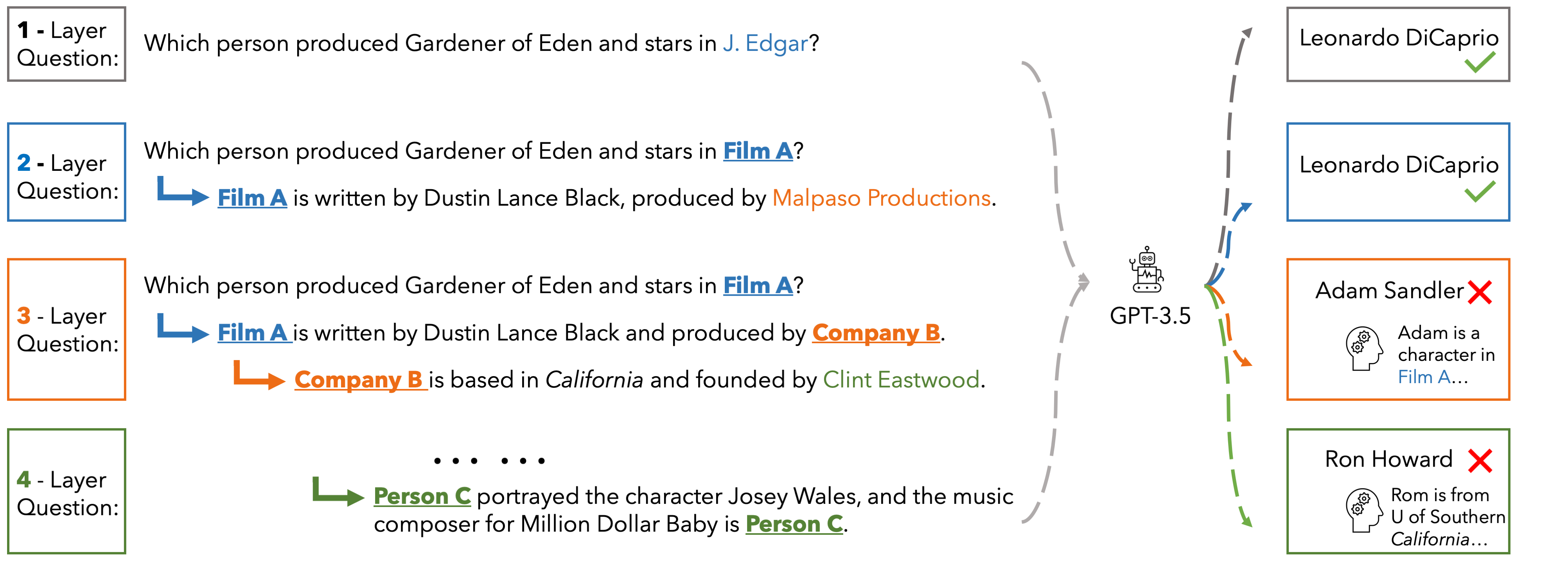
In EUREQA, every question is constructed through an implicit reasoning chain. The chain is constructed by parsing DBPedia. Each layer comprises three components: an entity, a fact about the entity, and a relation between the entity
and its counterpart from the next layer. The layers stack up to create chains with different depths of reasoning. We verbalize reasoning chains into natural sentences and anonymize the entity of each layer to create the question.
Questions can be solved layer by layer and each layer is guaranteed a unique answer. EUREQA is not a knowledge game: we adopt a knowledge filtering process that ensures that most LLMs have sufficient world knowledge to answer our questions.
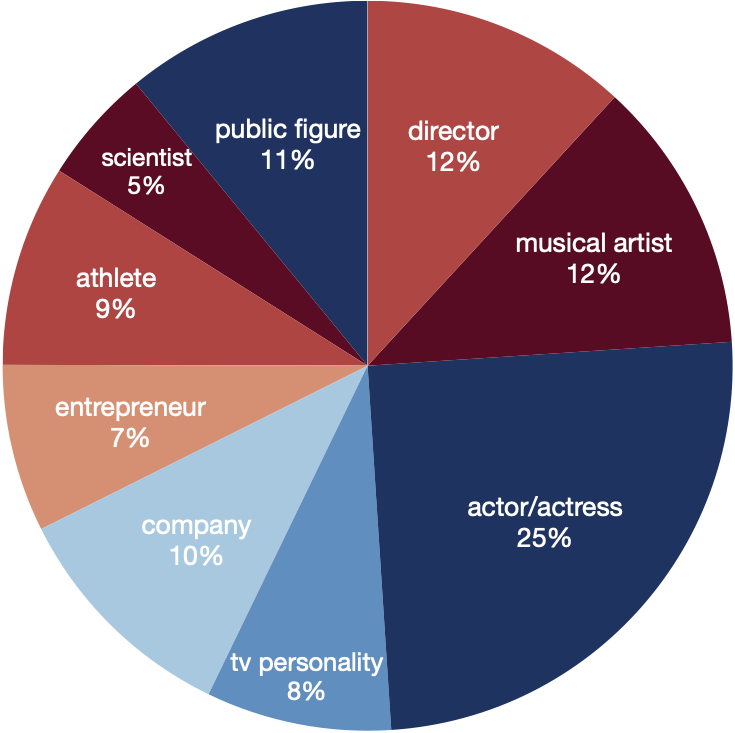
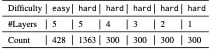
EUREQA comprises a total of 2,991 questions of different reasoning depths and difficulties. The entities encompass a broad spectrum of topics, effectively reducing any potential bias arising from specific entity categories.
These data are great for analyzing the reasoning processes of LLMs
 Performance
Here we present the accuracy of ChatGPT, Gemini-Pro and GPT-4 on the hard set of EUREQA across different depths d of reasoning (number of layers in the questions). We evaluate two prompt strategies: direct zero-shot prompt and ICL with two examples. In general, with the entities recursively substituted by the descriptions of reasoning chaining layers, and therefore eliminating surface-level semantic cues, these models generate more incorrect answers. When the reasoning depth increases from one to five on hard questions, there is a notable decline in performance for all models. This finding underscores the significant impact that semantic shortcuts have on the accuracy of responses, and it also indicates that GPT-4 is considerably more capable of identifying and taking advantage of these shortcuts.
| depth | d=1 | d=2 | d=3 | d=4 | d=5 | |||||
| direct | icl | direct | icl | direct | icl | direct | icl | direct | icl | |
| ChatGPT | 22.3 | 53.3 | 7.0 | 40.0 | 5.0 | 39.2 | 3.7 | 39.3 | 7.2 | 39.0 |
| Gemini-Pro | 45.0 | 49.3 | 29.5 | 23.5 | 27.3 | 28.6 | 25.7 | 24.3 | 17.2 | 21.5 |
| GPT-4 | 60.3 | 76.0 | 50.0 | 63.7 | 51.3 | 61.7 | 52.7 | 63.7 | 46.9 | 61.9 |
Maintenance is the final piece of the puzzle. Even a fixed source requires regular backups and monitoring. Because Growtopia is a live-service style game, the client frequently updates. Keeping your private server source compatible with the latest client version ensures that your players won't run into "version mismatch" errors. By starting with a clean, optimized, and fixed source, you save yourself hundreds of hours of debugging and provide a much better experience for your players.
Growtopia private servers allow players to host their own versions of the sandbox game with custom items and commands. However, many older source codes found online are riddled with bugs, security flaws, and crashing issues. Finding a "fixed" source is essential for anyone looking to create a stable environment for their community. growtopia private server source fixed
The core of a Growtopia private server is its source code, typically written in C++ or C#. The most common issues in older builds include broken world saving, non-functional inventory systems, and packet handling errors that cause the server to lag or crash. A fixed source addresses these technical debt issues, ensuring that the ENet protocol—the networking backbone of the game—is properly implemented. Maintenance is the final piece of the puzzle
Customization is the biggest draw for private server owners. Once you have a stable, fixed base, you can begin adding custom items, modified drop rates, and unique commands. Many fixed sources come with a pre-built "item.dat" editor, allowing you to modify item properties without breaking the game’s logic. This flexibility lets you create a unique economy or a high-speed "creative mode" experience that differs from the official Ubisoft servers. Keeping your private server source compatible with the
To get started with a fixed source, you will need a few essential tools. First, a compiler like Visual Studio is necessary for building the binaries from the raw code. You will also need to configure your web server, often using XAMPP or a similar stack, to handle the HTTP requests that the game client makes during the login process. This includes setting up the host file to redirect the official game traffic to your local or hosted server IP.
One of the primary benefits of using a fixed source is security. Unpatched sources often contain vulnerabilities that allow malicious users to gain administrator privileges or crash the server remotely. Fixed versions usually include updated database integration, often using SQLite or MySQL, which prevents data corruption and ensures that player progress is saved accurately every time they exit a world.
This website is adapted from Nerfies, UniversalNER and LLaVA, licensed under a Creative Commons Attribution-ShareAlike 4.0 International License. We thank the LLaMA team for giving us access to their models.
Usage and License Notices: The data abd code is intended and licensed for research use only. They are also restricted to uses that follow the license agreement of LLaMA, ChatGPT, and the original dataset used in the benchmark. The dataset is CC BY NC 4.0 (allowing only non-commercial use) and models trained using the dataset should not be used outside of research purposes.