Miodowe Lata Odc 1 Better 🆕 ⏰

RAPTOR is a flowchart-based programming environment, designed specifically to help students visualize their algorithms and avoid syntactic baggage. RAPTOR programs are created visually and executed visually by tracing the execution through the flowchart. Required syntax is kept to a minimum. Students prefer using flowcharts to express their algorithms, and are more successful creating algorithms using RAPTOR than using a traditional language or writing flowcharts without RAPTOR.
RAPTOR Web Edition (PREVIEW!)
Are you interested in running RAPTOR on Chromebooks, iPads, or just in a browser? Check out the pre-release here!. This is NOT fully tested. Send feedback via
RAPTOR Avalonia Edition (Multiplatform)
A Multiplatform version of RAPTOR is now available for Windows, Mac and Linux built on top of [Avalonia]!
See the downloads section below. Uses fonts from Noto Sans CJK for internationalization.
Key differences:
- Only Intermediate mode (subcharts and procedures, no OO)
- Will be able to load some files from Windows-only RAPTOR, but Windows-only will not load files from RAPTOR Multiplatform
- Documentation will be [online] instead of distributed with the app.
RAPTOR image and Papers
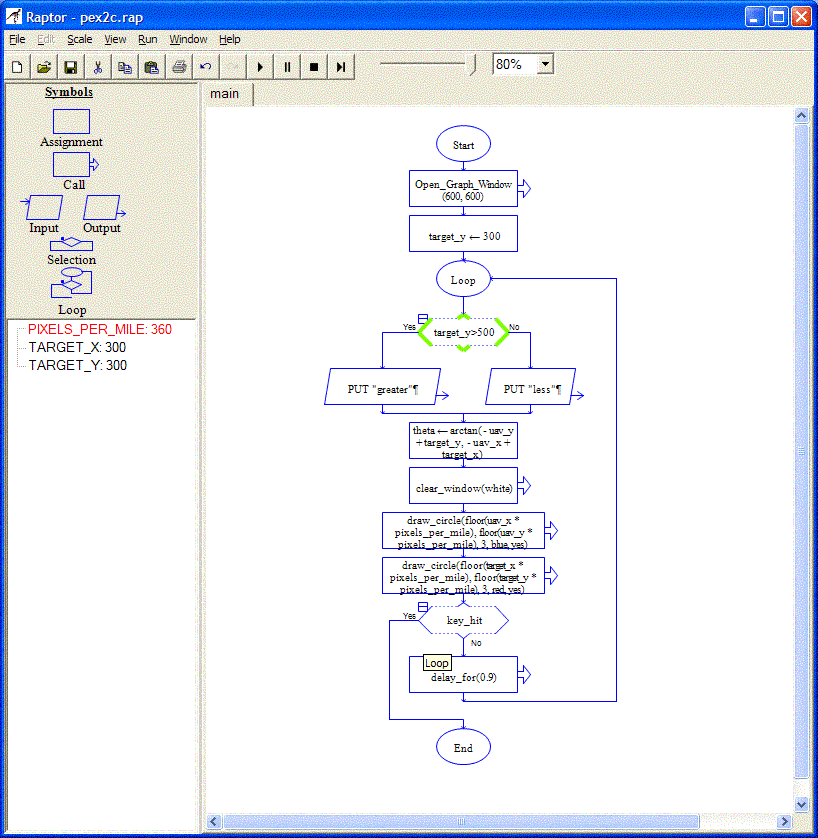
Figure 1 RAPTOR for Windows

Figure 2 RAPTOR Avalonia
Papers on RAPTOR application:
RAPTOR references
RAPTOR referenced in following books or publications:
- [view] An Introduction to Programming and Algorithmic Reasoning using RAPTOR (Hadfield, Weingart and Brown)
- [view] Starting Out with Programming Logic & Design (Tony Gaddis)
- [view] Prelude to Programming Concepts and Design (Venit and Drake)
- [view] School-based ICT (Longman Computer Course for Junior Secondary) (English and Chinese versions)
- [view] Introducción a la programación, Algoritmos y su implementación en VB.NET, C#, Java y C++
- books from Tsinghua University Press:
- [view] Visualized Computing 2012
- [view] Visualized Computing based On RAPTOR case tutorial 2014
- [view] RAPTOR programming case tutorial
When fans search for they aren't just looking for a link to watch the classic Polish sitcom—they are often expressing a common sentiment: the original pilot, "Żywe zwłoki" (Living Corpses) , sets a bar for comedy that many modern shows struggle to reach. Premiering on October 13, 1998, this episode introduced Poland to Karol Krawczyk and Tadeusz Norek, sparking a cultural phenomenon that lasted for years. The Plot: A Masterclass in Misunderstanding
The first episode, " Żywe zwłoki ," perfectly encapsulates the "Krawczyk-style" chaos. The story kicks off with a classic sitcom trope done right: . Karol, a hot-headed tram driver, accidentally mistakes the results of a dog’s medical exam for his own. Convinced he has only six months to live, he decides to "protect" his wife Alina’s future by selling his life story to a tabloid.
Episode 1 features the original Alina, played by Agnieszka Pilaszewska . While later seasons saw Katarzyna Żak take over the role, many "purists" prefer the early dynamic and the specific "fire" Pilaszewska brought to the character's interactions with Karol. Legacy of the Pilot Miodowe Lata - Żywe zwłoki - Polsatboxgo.pl
The comedy peaks when the error is discovered. Rather than coming clean, Karol’s pride—and his fear of the consequences—forces him to keep up the charade, leading to a spiral of lies that only his best friend, the naive sewer worker Tadek Norek, could make worse. Why Episode 1 Still Holds Up
Unlike modern sitcoms filmed on closed sets with canned laughter, Miodowe Lata was performed in front of a live audience. The timing of Cezary Żak (Karol) and Artur Barciś (Tadek) was honed by the immediate feedback of the crowd, making their legendary chemistry feel electric from minute one.
Miodowe Lata Odc. 1: Why the Pilot Is Still "Better" Than Modern Sitcoms
Many viewers argue that the early episodes, especially the pilot, feel "better" because of the unique atmosphere of the where it was filmed.
As a Polish version of the American classic The Honeymooners , the pilot had to bridge two cultures. It succeeded by making the characters feel quintessentially Polish—struggling with 1990s economics, living in a gritty Wola apartment, and dreaming of "big money" through hilariously flawed schemes.
RAPTOR Avalonia Common issues
Miodowe Lata Odc 1 Better 🆕 ⏰
When fans search for they aren't just looking for a link to watch the classic Polish sitcom—they are often expressing a common sentiment: the original pilot, "Żywe zwłoki" (Living Corpses) , sets a bar for comedy that many modern shows struggle to reach. Premiering on October 13, 1998, this episode introduced Poland to Karol Krawczyk and Tadeusz Norek, sparking a cultural phenomenon that lasted for years. The Plot: A Masterclass in Misunderstanding
The first episode, " Żywe zwłoki ," perfectly encapsulates the "Krawczyk-style" chaos. The story kicks off with a classic sitcom trope done right: . Karol, a hot-headed tram driver, accidentally mistakes the results of a dog’s medical exam for his own. Convinced he has only six months to live, he decides to "protect" his wife Alina’s future by selling his life story to a tabloid.
Episode 1 features the original Alina, played by Agnieszka Pilaszewska . While later seasons saw Katarzyna Żak take over the role, many "purists" prefer the early dynamic and the specific "fire" Pilaszewska brought to the character's interactions with Karol. Legacy of the Pilot Miodowe Lata - Żywe zwłoki - Polsatboxgo.pl miodowe lata odc 1 better
The comedy peaks when the error is discovered. Rather than coming clean, Karol’s pride—and his fear of the consequences—forces him to keep up the charade, leading to a spiral of lies that only his best friend, the naive sewer worker Tadek Norek, could make worse. Why Episode 1 Still Holds Up
Unlike modern sitcoms filmed on closed sets with canned laughter, Miodowe Lata was performed in front of a live audience. The timing of Cezary Żak (Karol) and Artur Barciś (Tadek) was honed by the immediate feedback of the crowd, making their legendary chemistry feel electric from minute one. When fans search for they aren't just looking
Miodowe Lata Odc. 1: Why the Pilot Is Still "Better" Than Modern Sitcoms
Many viewers argue that the early episodes, especially the pilot, feel "better" because of the unique atmosphere of the where it was filmed. The story kicks off with a classic sitcom trope done right:
As a Polish version of the American classic The Honeymooners , the pilot had to bridge two cultures. It succeeded by making the characters feel quintessentially Polish—struggling with 1990s economics, living in a gritty Wola apartment, and dreaming of "big money" through hilariously flawed schemes.
About Windows RAPTOR Modes
Did you know RAPTOR has modes? By default, you start in Novice mode. Novice mode has a single global namespace for variables. Intermediate mode allows you to create procedures that have their own scope (introducing the notion of parameter passing and supports recursion). Object-Oriented mode is new (in the Summer 2009 version)
RAPTOR is Free!
RAPTOR is freely distributed as a service to the CS education community. RAPTOR was originally developed by and for the US Air Force Academy, but its use has spread and RAPTOR is now used for CS education in over 30 countries on at least 4 continents. Martin Carlisle is the primary maintainer, and is a professor at Texas A&M University.
Authors
Avalonia Edition
Windows Edition
Feedback
Comments, suggestions, and bug reports are welcome. If you have a comment, suggestion or bug report, send an email to .
Forum
David Cox has put together a user forum at http://raptorflowchart.freeforums.org. This provides a place for users to exchange ideas, how tos, etc. Note however, that feedback for the author should be sent by email rather than posting on this forum.
Youtube Videos
Randy Bower has some YouTube tutorials at http://www.youtube.com/user/RandallBower. You can also search YouTube for "RAPTOR flowchart".
Acknowledgements
The UML designer is based on NClass, an open-source UML Class Designer. NClass is licensed under the GNU General Public License. The rest of RAPTOR, by US Air Force policy, is public domain. Source is found here. RAPTOR is written in a combination of A# and C#. Unfortunately, I don't have the time to provide support on compilation issues